In high-volume molding, some of the most valuable seconds are spent cooling.
When you’re producing hundreds of thousands, or even millions, of components, small improvements quickly become significant. A few seconds removed from each cycle can translate into substantial gains in capacity, energy efficiency, and cost.
That makes cooling much more than a technical detail.
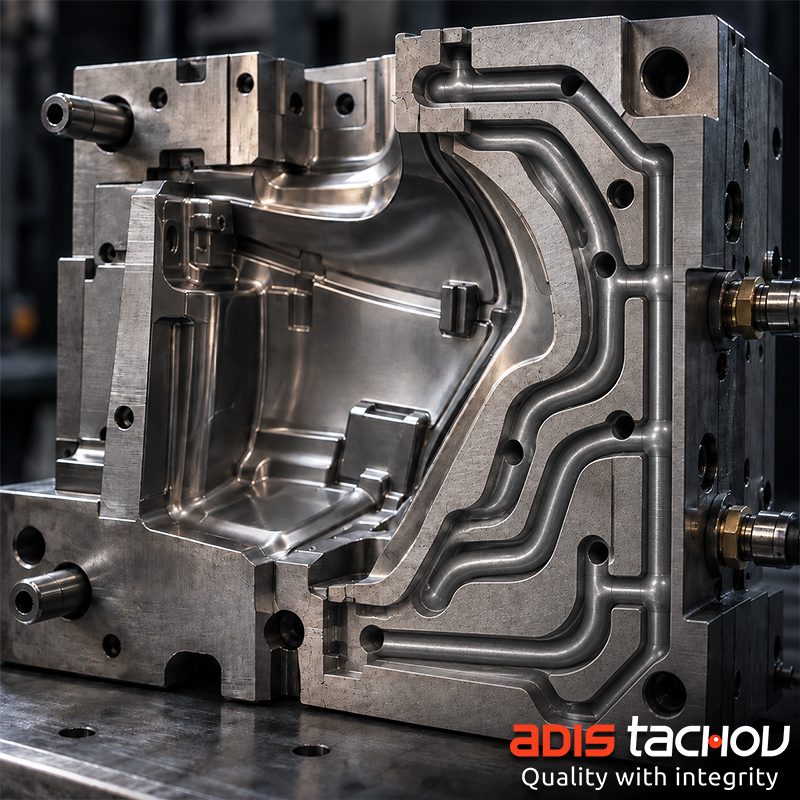
Traditional mold cooling relies largely on straight drilled channels. They can work extremely well, but complex part geometries often make it difficult to position those channels evenly around the cavity. The result can be localized hot spots, uneven cooling, longer cycles, and a greater risk of warpage or dimensional variation.
Conformal cooling takes a different approach. 🧐
Using advanced mold manufacturing techniques, cooling channels can follow the geometry of the component much more closely. That allows heat to be removed more evenly from areas that conventional channels may struggle to reach.
More consistent cooling can improve dimensional stability, reduce thermal variation across the part, lower defect risk, and help create a more repeatable process. Shorter cooling phases can also reduce the energy required for every component produced.
For automotive programs, where volumes are high and tolerances are tight, those improvements compound quickly.
At ADIS Tachov s.r.o., conformal cooling is one of the tools we use when the application justifies it. The goal isn’t simply to make the mold more sophisticated, it’s to create a more stable, efficient production process that keeps delivering the same quality part, cycle after cycle. 🦾